– timely environmental care on real estate transactions
Many factors need clarification for the determination of the market value when transaction of real estate property takes place. One of the most important factors are assessment of possible costs related to soil and groundwater contamination and harmful substances in the buildings (PCBs, lead, asbestos, mold mm.).
Dansk Miljørådgivning A/S (DMR) has many years of experience in conducting environmental site assessments (ESA) of many different types of businesses.
Both seller and buyer with their own advisers often carry out the assessments. DMR has experience in the preparation of assessments as part of the sale documents or for the potential buyer.
The assessments are always carried out in close cooperation with the customer and other relevant advisers in the process. The work is carried out by international guidelines (ASTM) or by tailored specific requirements from the customer.
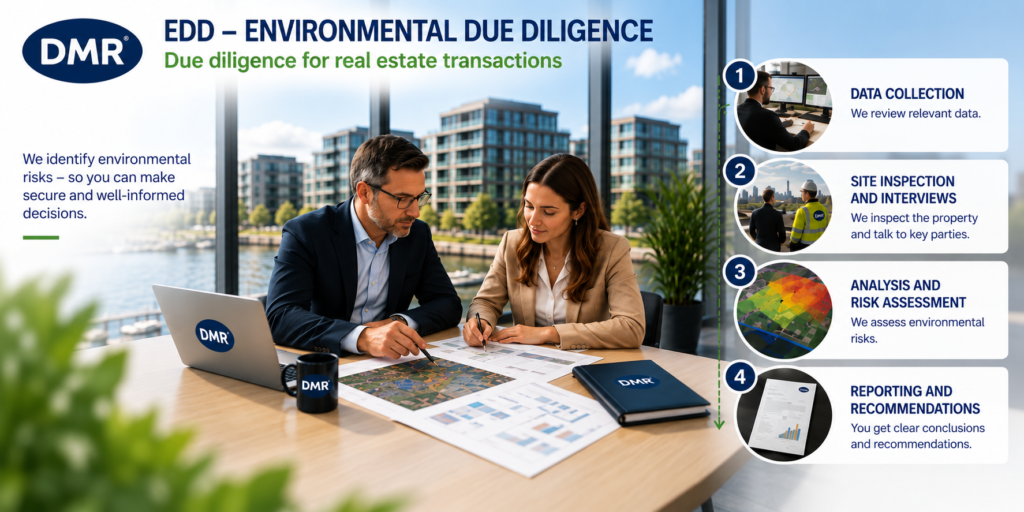
The assessments – the process often referred to as Environmental Due Diligence (EDD) – includes three phases, where often only the first phase is carried out.
Phase 1 is defined by the American standard ASTM E1527. The work includes
- Information gathering from a physical/virtual data room
- Visiting the property
- Interviews with relevant site staff
- Reporting of relevant data and assessments thereof, including potential and liable economic costs associated with the findings and recommendations.
Phase 2 is defined by the American standard ASTM E1903. The work includes
- Field studies of outstanding considerations, recommended in phase one
- Reporting of the studies, including the potential economic costs of any potential remediation or mitigation measures.
Phase 3 includes the implementation of remediation or mitigation measures.
Reporting is communicated as a starting point in Danish, English, German or Norwegian.
DMR performs obviously the work with the utmost discretion.
Assignments outside Denmark and Norway can be solved in close cooperation with local consultants.
Contact person
FAQ: Environmental Due Diligence
An Environmental Due Diligence is an environmental assessment typically carried out in connection with the acquisition or sale of a property or business. The purpose is to identify environmental risks and potential financial liabilities, for example related to soil and groundwater contamination and hazardous substances in buildings.
An EDD is typically carried out before the acquisition or sale of commercial properties and businesses where environmental conditions may affect the purchase price or result in future liabilities. The assessment can be carried out on behalf of either the buyer or the seller.
A Phase I typically includes a review of available information and documents, a site inspection and interviews with relevant persons. Based on this information, potential environmental risks are identified and recommendations for any further investigations can be provided. DMR can also assess potential financial costs associated with the identified environmental conditions.
If the Phase I assessment identifies environmental conditions that cannot be sufficiently clarified based on the available information, field investigations may be required. These may include sampling and analysis of soil, groundwater or building materials to determine the extent of potential contamination.
Yes. An important part of an EDD can be to assess the potential financial consequences of identified environmental conditions. These may include expected costs for further investigations, remediation, mitigation measures or the management of hazardous materials.

